
In general, a blowdown system removes a small portion of water from a steam drum in order to limit the buildup of dissolved salts, corrosion products, and suspended impurities that concentrate as steam is produced. This helps maintain feedwater quality and protects equipment from deposits. In the RBMK, this function is combined with a cooldown path, so the extracted water can also be cooled, treated, and returned or routed as needed, giving the system a secondary role in removing heat from the circuit.
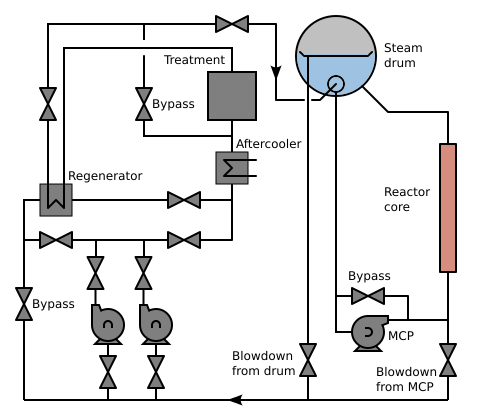
Note that there is only one blowdown system for both steam drums. Only one side is shown in the description here.
There is a level balance control available that uses the return valves to keep the drum levels equal.
Cooldown Operation
By bypassing the feedwater purification and treatment, the system is used to remove decay heat and cool the reactor during maintenance or when offline.
When no Main Circulation Pump (MCP) is active and the bypass is open, the water naturally circulates due to the different densities of hot and cold water. One pump of the blowdown system is used to pump the hot water through the aftercooler, the treatment system is bypassed. This is the initial state when the RBMK simulator is started.
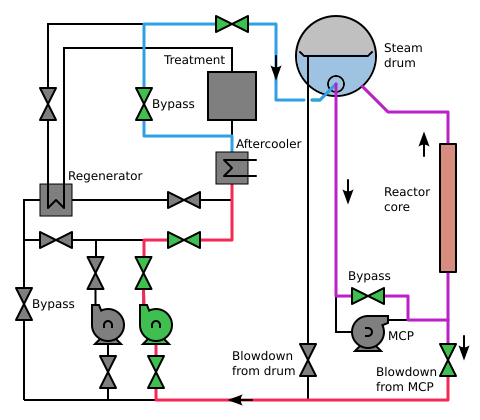
Note that the cold water returning from the blowdown/cooldown system is mixed into the feedwater intake into the steam drum so it gets mixed with the already circulating water and the mixture is also fed back into the cooldown system. This limits the efficiency of the cooldown system.
With one MCP online and bypass closed, the pumps of the blowdown system can be bypassed. This cools down the reactor more efficient that the passive natural circulation mode.
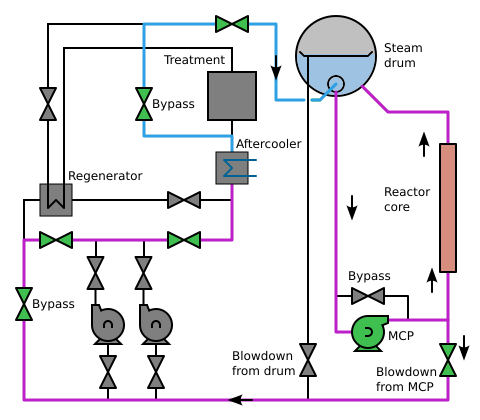
With the MCP offline, Loop Bypass closed and the blowdown pumps active, the water can be circulated in the other direction through the core. This is used to prepare the reactor core for maintenance and provides the most efficient way of cooling down the core.
Blowdown operation
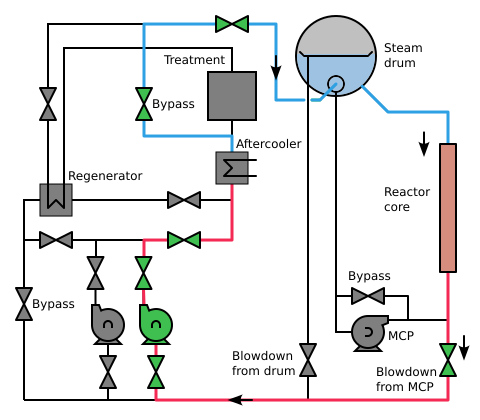
During operation, a regenerator heat exchanger is used to keep the heat inside the core. The aftercooler is still needed to cool down the feedwater to a lower temperature for the purification treatment.
During startup, the blowdown water can be taken from the MCP pressure header.
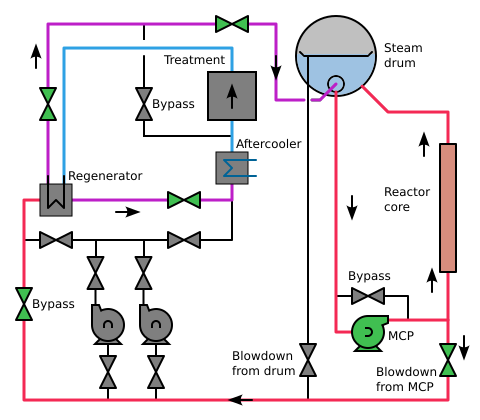
During reactor operation, the water is taken from the top of the steam drum at the water surface as most byproducts concentrates on top where the water and steam separates.
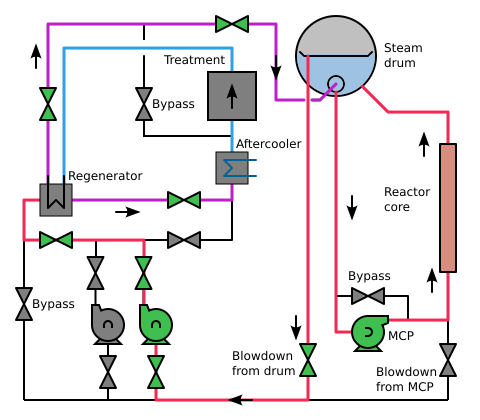
When do you transition from startup to Reactor operation?